


- 10 May, 2022
- Kristen Haas Curtis
- in Diary Pages
Chaucer in the Alps
In May, I taught a workshop on Chaucer and adaptation in a chalet in the mountains for the University of Lausanne. Fondue was eaten, walks were taken, magic was performed, and many birds were drawn.

In what has been one of the most enjoyable experiences of my academic career so far, I was invited to spend a weekend at a chalet in the mountains owned by the University of Lausanne as the guest speaker for their “Chaucer in the Alps” event – the first since the onset of COVID. For our weekend, I chose Chaucer’s “Parliament of Fowls” as our text and “adaptation studies” as our chief focus.
My plan for the weekend was built on lessons I’ve learned from adapting texts as a part of my own research (particularly my work adapting Chaucer’s “Nun’s Priest’s Tale”) – not only would we be reading the text together over the weekend, but if everything worked out as planned, we would be creating our own group adaptation as well! I’ve been thinking a lot these past few years about adaptation as a process as well as a product, as outlined by Linda Hutcheon in her 2006 book A Theory of Adaptation, and it was this idea with which I wanted to experiment alongside the attendees.
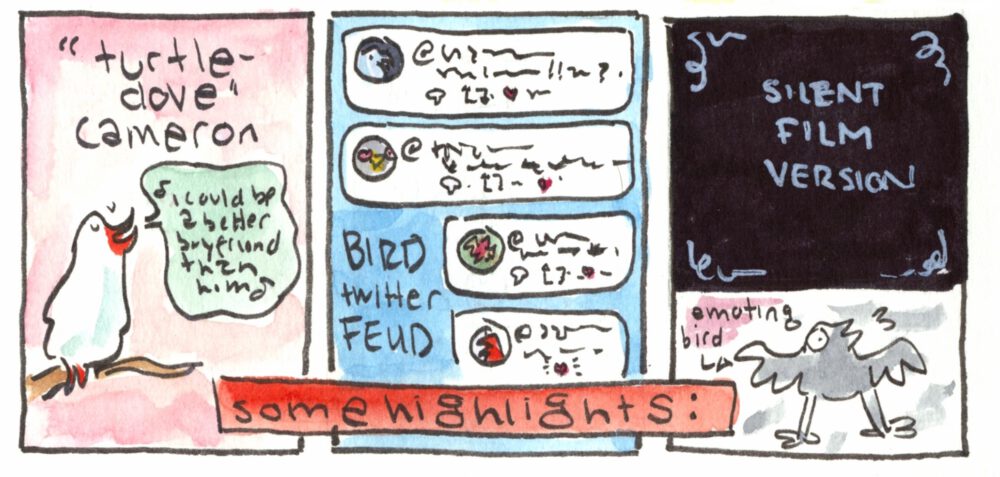
Over the course of multiple exercises of increasing complexity, attendees worked through the text with an eye for the different routes an adaptation might take. We started off reading the opening of the text together before breaking down into smaller reading groups. Each session included a short discussion question and an exercise geared towards getting attendees thinking about what it means to adapt a text. For our final exercise, attendees drew two random stanzas out of the ‘hat’ and had two hours, working individually, to adapt their stanzas, once in text form and once in word/image form. Text options explored by attendees included haiku, sonnet, word collage, and more. Word/image formats included single panel gag comics, full page illustrations, four panel comics, and others. Once completed, all adapted stanzas were collected in order and a pdf of our completed work was shared with attendees the following week. It was a hit!
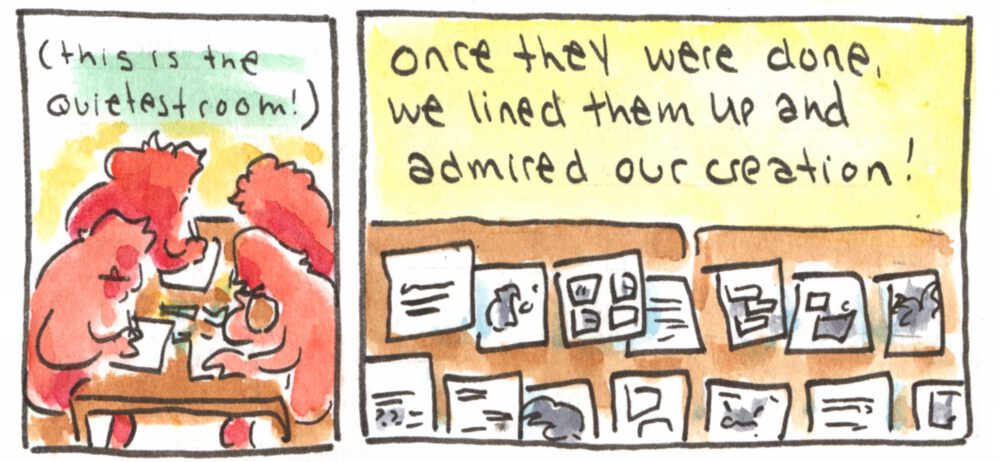
Seeing and hearing the excitement as attendees discussed the text and thought through all the options that adaptation could offer was very gratifying. During the final work session in which all the attendees adapted their stanzas, the absolute silence that fell over the room was amazing to witness: everyone was so deeply engrossed in their reading and thinking. The adaptations they created were beautiful and hilarious and touching by turns and worked together surprisingly well in the final collected version.
If you click through to the 2022 Diary, you can read my full write-up of the event.
Interested in collaborating on a similar event at your university? Drop me a line through the contact form – I would love to talk about it!
